2024
Califf, S., Nair, M., Weimer, D., Zachman, N., & Poedjono, B. (2024). Assessment of the Weimer geomagnetic perturbation model for high-latitude positioning and navigation. Space Weather, 22, e2024SW004005. https://doi.org/10.1029/2024SW004005
Califf, S., Nair, M., Weimer, D., Zachman, N., & Poedjono, B. (2024). Assessment of the Weimer geomagnetic perturbation model for high-latitude positioning and navigation. Space Weather, 22, e2024SW004005. https://doi.org/10.1029/2024SW004005
Chen, R., Zhao, H., & Califf, S. (2025). Observations of fast local loss of high-energy ring current protons associated with deepening local minimum in phase space density. Geophysical Research Letters, 52, e2024GL112530. https://doi.org/10.1029/2024GL112530
Note: The observatory-based Dst (plotted for comparison) are obtained from the World Data Center for Geomagnetism in Kyoto. These "Quicklook" Dst values are unverified, may contain errors, and are subject to change.

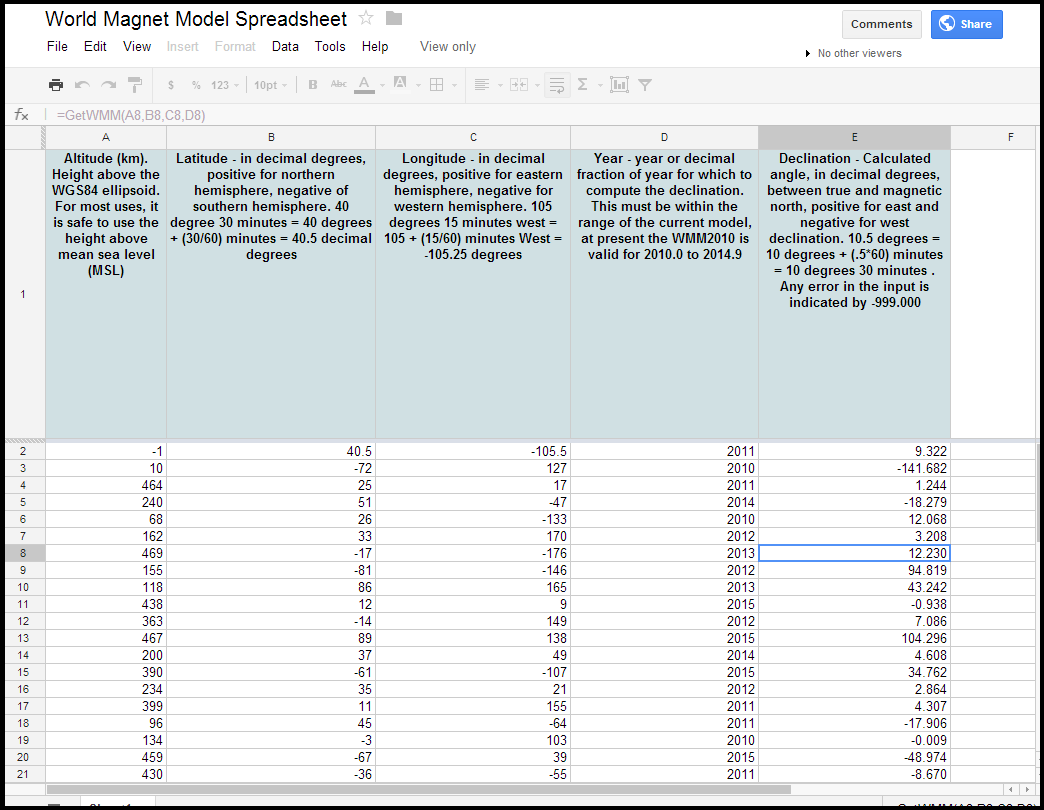
This Google Sheets application provides a convenient way to calculate the Earth's main magnetic field components using the official World Magnetic Model (WMM) 2025. The WMM is a standard model developed by the US National Oceanic and Atmospheric Administration (NOAA) and the British Geological Survey (BGS), representing the global magnetic field for a specific five-year epoch.